
A Fragment of Grief
Grieving is a funny thing. You don’t know exactly how you’re going to be affected by it. It could be days, weeks, hours, months, years, even decades after the untimely demise of a loved one. And you could all of a sudden feel caught up, dragged away by the eddy current of whatever memory has suddenly been prompted or sparked — by a sight, a scene, a smell, a sound, a texture from your shared past. Grief strikes you when you least expect it, but perhaps when you most need it.
I don’t know that I grieved my father’s death in 2006 in the way that I intended or wanted. For all intents and purposes, I did grieve his death. I was at the funeral. I was with my family. I stood by the graveside. I went to the funeral home where he passed in Pittsburgh and was with my mom as she took care of the necessities of the bereaved. The stories that emerged from those preparations were simultaneously funny and macabre. Paying for a funeral with your credit card to get air miles is dark humor at the finest. Same goes for knowing that bodies get FedEx’d home.
I remember finding out that my father had died and immediately falling to the ground crying, because the emotion was there. It was something I didn’t understand. I’d never come face to face with it before in such an intimate and personal way. I couldn’t see my father at the funeral home to identify him; I let my brother do that. For me, the experience of seeing a dead body was too great a task at the time.
Minutes turned into hours, hours turned into days, days turned into weeks, weeks turned into a year. Life moved on.
I had the bits and pieces and reminders of my father. I had the white Honda Civic that he had driven across the country because my brother chose not to go to college. It was a strange reminder of the calculated cruelty my father could exhibit while simultaneously seeming to engender care. I learned how to drive manual in that car, so I suppose something stuck.
I had conversations with my father before his death that reinforced some of the bad familial choices that had followed from his generation to mine. Those struck me again after his passing.
A year turned into years.
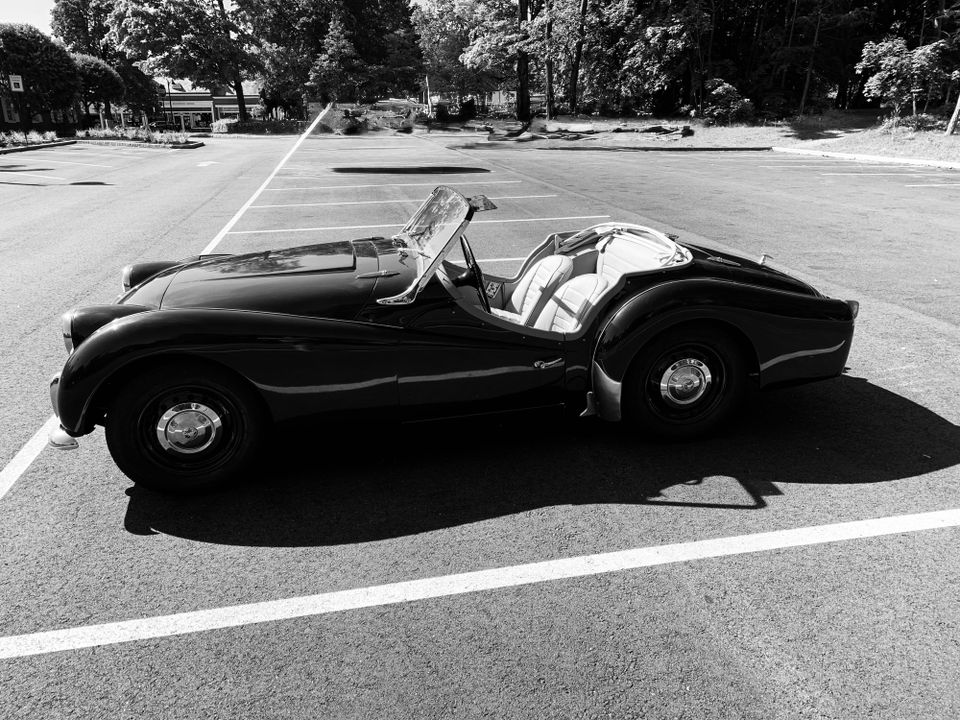
I had a conversation with my mother on one of my trips back to the town I grew up in about my father’s first car, a 1963 Triumph. He had left it in a barn, then taken it back to California and frame-off restored it. My brother and my mom didn’t want it, and they said I could have it. So began the negotiation for shipping it across the country, from California to Massachusetts. FedEx came to rescue, once again.
And there was excitement over this something that was a tangible reminder of my father — something that wasn’t a misdeed, or wasn’t an absence. It wasn’t a malformed approach to love and understanding. It was something that, in essence, was pure expression of who he was: reshaped, recolored, reframed, reinvigorated, reimagined. And then, probably, in an ironic sense — because it was an English car, just as fraught with inherent deficiencies and dysfunctions as, well, as my father truly was.
I don’t recall my father being perfect, far from it. He treated my mom terribly, both in apathy and in aggression. He treated my brother — from my brother’s telling — with a casual dismissal, because my brother refused to accede to my father’s ideals of what he should be.
I was, perhaps, the golden child. I pursued the education my father wanted. I got my master’s degree. I got into computers. I did the things that my father wanted his son — his sons — to typify: a highly educated, highly socially mobile kid, to the extent possible. Perhaps he saw in me the success that he didn’t see in my brother, wrong as it may be. History will be the judge, but it certainly hasn’t played out quite as he thought.
I don’t know that I’ve grieved my father correctly. I don’t know that I’ve forgotten my father at all. I know that I relived memories of my father and the things that he chose to do. And the most visceral representation of that was truly the Triumph.
This last week, the Triumph was sold to an older gentleman from New York who bought it for his wife. It had been my insistence all along that selling the Triumph, while precipitated by an international move from Boston to Ireland, was an act of legacy investment. It was giving to another the opportunity to continue the slow dance of history, if only for a small bit of time.
That quaint little, quirky, idiosyncratic piece of British machinery first roared to life in the early ’60s. It’s visceral: a tin can with four wheels and an attitude to match.
The sale wasn’t about money. It was about embracing a legacy. It was about passing that legacy on to someone who would recognize it for what it could be and continue it in ways I could no longer.
Regardless of whether things were modernized or replaced with original equipment, that didn’t matter. You weren’t ripping the soul out of the memory. You were replaying that memory over and over again, interstitially, whenever you took it out for a drive. And while that memory for this new guy would not be the same as when I drove that car, it was at least as powerful — if not more so — for him to be able to drive it with his wife than it would be for me to have it sit in a garage and rust away into oblivion.
Grief is like that a lot of the time. Grief becomes rusting. It becomes the car left unattended in a barn somewhere in the cornfields of Illinois. It becomes something you don’t understand, don’t recognize, don’t realize you’ve missed — until it suddenly and powerfully comes back. It smacks you in the ass and says, “Hey. It’s been 20 years. It’s been two decades.” Two decades of oblivion. The subtle reminders here and there, screaming from the void, saying, “Hey, do you remember?”
It’s been remembering some of these moments in the midst of the chaos of my own life — my own having to grieve choices I made that caused death to relationships. It’s having to live and relearn and understand what it meant to be my own me, to suffer the consequences of my own choices, to understand what it means to tear something apart and put it back together again. That was the Triumph.
So while I don’t believe I ever grieved appropriately, or readily, or maybe at all — this past Saturday, I gave away the last fragment of my grief. The last physical and tangible reminder of a man who was my father, a man who adopted me, a man who was as broken as a shattered mirror on the floor. But someone who still, and yet, persists through time.
Part of giving up the Triumph was sorting through old paperwork — bills, receipts, jotted notes my father had scrawled, evidently in haste, in his barely legible, if not fully illegible, doctor’s script. Paint colors, and his signature, and the flip sides of a lawsuit he went through during his time as a doctor. And all of these bits and pieces and moments and existences — all of these things I got to peer through once again.
Again — perfectly imperfect human that he was — I relived what it was like to read his handwriting. I relived what it was like to try to understand the logic behind who and what he was. He was fastidious in ways I didn’t understand and still don’t. And he was absolutely sloppy in ways that I, perhaps, embody myself.
The car was grief. The paperwork was grief. The moments were grief. I took a snapshot of the car title — my father’s signature on it, and his Social Security number. I have those now as digital memories, preserved in some overbaked hull of a data center somewhere, probably in the United States, but at this point, who knows? Digital bits flinging back and forth between spinning hard drives, flash drives, or whatever mysterious ether gets chosen as the next medium. Those are memories. Those are the things that will, hopefully, persist for more years.
I’m 48 now. My father died when I was 28. I hope I outlive my father. He died at 59. I’ve got 11 years to go before I pass that Rubicon. My mom’s 80. I hope she has another decade-plus to live, even though she may not want the same. I don’t want to face things in the same way. I don’t want to breathe in the same way. I don’t want to grieve at all, frankly, because grief, to me, is terrifying.
Grief is utterly rending. Grief rips apart the essence of your soul and shatters it over and over and over again, and then attempts to stitch it back — only to be stepped on again, and again, while the scar tissue builds over the wounds. You can recover from grief. Absolutely.
We are resilient in ways we never understood and still don’t, to this day. We will grieve. We will die. We will become nothing, or something — one can never really tell. But for me, I had a moment of grief. I had a reliving. A visceral shard of memory that I got to give up. Give away. And use to bless another. And I think, from that perspective, there is no greater way — whether it establishes my father’s legacy or not, whatever — to understand the grief of things than to let go of the Triumph.
I suppose the challenge, for any of us, is that we allow grief to be natural. That we allow grief to run its course — to stomp and shatter and remake and re-mend and cauterize and rip and tear, as much as it needs to. Because the result is that we’ll wake up one morning, 20 years down the line, and suddenly come to understand that it’s okay. It’s finished. It doesn’t need to be anymore.
Maybe it’s in the letting go of that… that we are made whole.
May it ever be so.